

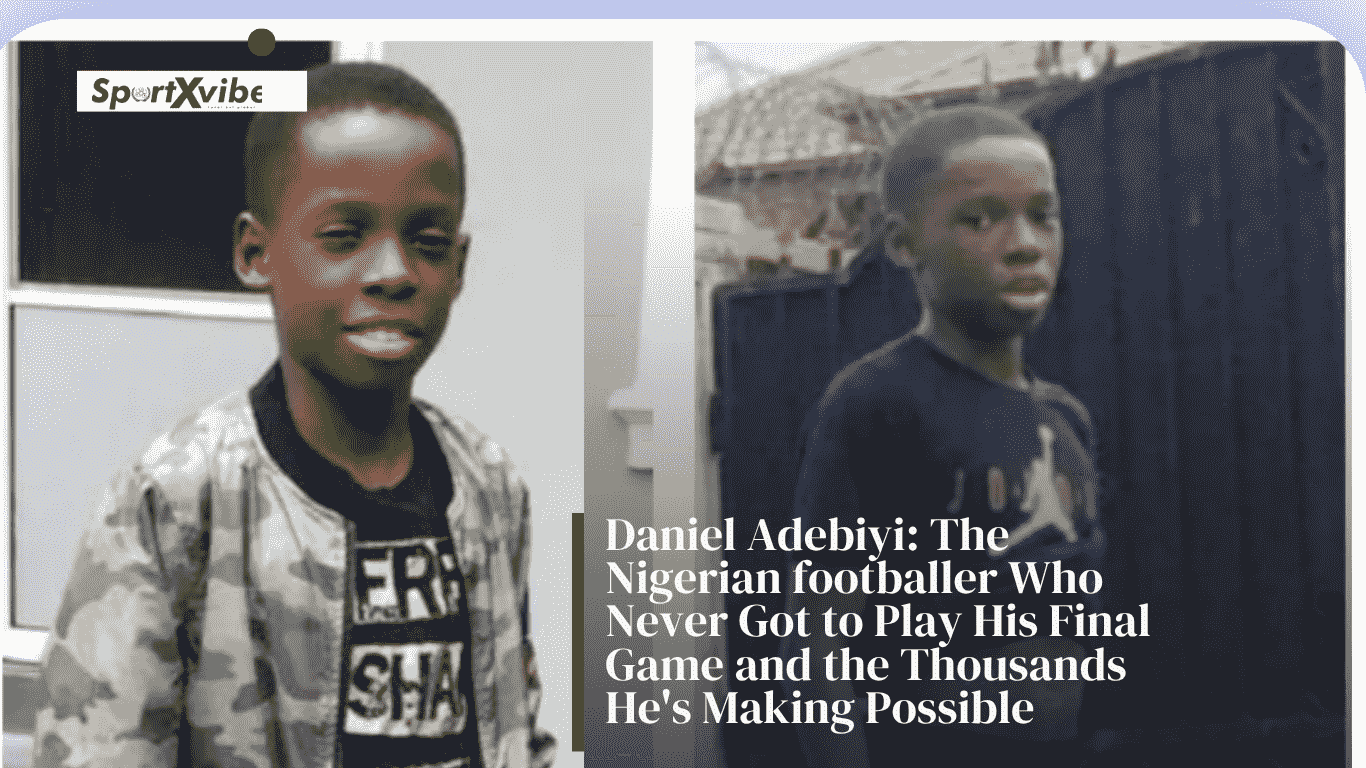
He had the soccer scholarship, the track scholarship, and the academic scholarship; all three, simultaneously, at Chrisland School in Lagos. He was the kind of player about whom coaches said impossible things: that if Daniel was not available, rival schools would ask to reschedule the match. He was fifteen years old.
His name was Daniel Oreoluwa Adebiyi. Born on July 2, 2005, in Snellville, Georgia, he carried his talent across an ocean when his family relocated to Nigeria, and he planted it in the red soil of a football pitch in Lagos and watched it grow into something that made everyone around him believe.
He had chosen his mentor, Cristiano Ronaldo and was on the cusp of SS2 when the next stage of his journey, a football academy, was supposed to begin. He was studying those who had made it. He was preparing to become one of them.
In the early hours of September 9, 2020, after a brief and sudden illness, Daniel Oreoluwa Adebiyi went to be with the Lord.
He was fifteen years and sixty-eight days old.
He left behind his parents, Pastor Mike and Pastor Mrs. Adenike Adebiyi, and his brothers Michael, Samuel, and Emmanuel. He left behind a school that would feel his absence for years. And he left behind a gap in his family, in Nigerian youth football that would either remain a wound, or become, somehow, a door.
The opportunity that death took away from him, we want that opportunity to be multiplied to so many young superstars that we otherwise would not have.
A FATHER’S ANSWER TO THE UNANSWERABLE
Grief, for some parents, turns inward quietly, permanently. For Dr. Mike Adebiyi, it turned into action. Within a year of Daniel’s passing, he had established the D.O.A. Foundation and organised the first edition of a school football tournament in his son’s name. Not as a ceremony. Not as a once-off tribute. As a structure. A system. A platform built to do exactly what Daniel’s life had been building toward.
Five years later, the Daniel Oreoluwa Adebiyi Football Tournament has just completed its fifth edition. This year, eight schools competed. Next year, the number is expected to double to sixteen. After that other states. And eventually, the plan that animates Dr. Adebiyi’s every conversation about it: a national competition broad and competitive enough to identify an MVP truly worthy of a place at a football academy abroad.
“It’s building up. It’s a process. It’s not a one-off thing. In everything, planning is 75% of success. We have a structure we are following and it’s building up based on our plan.” — Dr. Mike Adebiyi, CEO, D.O.A. Foundation.
The prize money in this fifth edition ₦300,000 for first place, ₦200,000 for second, ₦100,000 for third is real money for a school athlete. But the foundation is clear-eyed about what the competition is not yet producing.
The MVP right now, Dr. Adebiyi explains, is the best among those present. That is not yet the same as being ready for a foreign academy. The competition must grow first. The talent pool must deepen. The standard must rise to match the ambition.
That clarity is itself remarkable. Many foundations built on grief rush toward the grandest gesture, the most visible outcome, before the scaffolding is in place. The D.O.A. Foundation is, deliberately and methodically, building the scaffolding first.
THE LEGENDS WHO CAME
There is a detail in the story of this foundation that says everything about the kind of boy Daniel was: the late Peter Rufai, Nigeria’s greatest goalkeeper and an icon of African football, was one of Daniel’s coaches.
When the foundation was established, Rufai was among the first to commit to it, not as a patron or a figurehead, but as a man who had known the boy personally, and who therefore understood exactly what had been lost.
Before his own death, Rufai had mapped out what the foundation’s football programme could become: bringing in scouts, inviting more legends of Nigerian football, creating the kind of environment where a gifted teenager in Lagos might look across a pitch and see the person they wanted to become standing right there, offering advice.
He had made a personal commitment to use his influence to move the foundation toward its goals.
At the fifth edition, former Nigerian international Ifeanyi Udeze was among those present. His words were direct and unembellished, the words of a man who had come through grassroots football himself and understood what these early opportunities mean.
“You never can tell who will be the next Kanu Nwankwo, JJ Okocha, Celestine Babayaro, Taribo West. It is a good initiative. We don’t have much of this kind of tournament. That is why I am happy to be here. It gives me joy. It gives me hope. It gives me that belief that once again, yes, we are going back to the grassroots we can catch them young, pick them young, and you never can tell what can happen tomorrow.” — Ifeanyi Udeze, Nigerian Ex-International
CHRISLAND’S WITNESS
For Chrisland Group of Schools where Daniel had been, in the words of Eric Van Der Merwe, Head of Schools, Sports and Wider Curriculum, the annual tournament has become something more than a competition. It has become a communal act of reckoning.
Remembering that sport, at any age, is not guaranteed. That a boy can hit another boy’s knee on a football pitch and everything can change in a moment. And that the right response to that truth is not to pull back from life, but to flood it with meaning.
“Life can be taken away at any point in time. That’s what we are trying to teach our students through Daniel’s death. Live every day to the fullest. Make the best of your opportunities.”— Eric Van Der Merwe, Head of Schools, Sports and Wider Curriculum, Chrisland Group of Schools
Van Der Merwe is candid about the progress of the last three years, since Chrisland became more deeply embedded in the tournament’s organisation.
The event has evolved from a largely internal Chrisland affair into a genuine inter-school competition with increasing community reach. Public schools, he says, are the next frontier. The family’s wish to make this a community project, to ensure that more people know there was a boy called Daniel, that his parents chose to honour him this way is becoming reality, year by year.
“It’s not about money. Life is not about money. Life is about remembering the finer things in life having somebody around you. And losing your boy in these circumstances is tragic. If this is their way of dealing with it, we can only support them.” — Eric Van Der Merwe, Chrisland Group of Schools
THE LEGACY BEING WRITTEN
Five editions in, the D.O.A. Foundation sits at a threshold. The foundation is still privately funded entirely, Dr. Adebiyi notes with quiet firmness, by the family. There has been no Lagos State Sports Commission partnership, no government involvement yet.
The sponsorship is not money to him. It is Daniel’s legacy. And that is not something he is prepared to dilute with conditions that do not serve the mission.
What is coming, in Dr. Adebiyi’s telling, is a significant expansion in media presence and public profile. Television. National press. A competition that, when it reaches every state, will have the reach to mean something — to the clubs watching, to the scouts circling, to the young boy in Enugu or Kano or Port Harcourt who does not yet know that a tournament named after a boy he never met might be the platform that changes his life.
The female category remains a future consideration. Daniel was a male athlete, and for now the focus remains there. But Dr. Adebiyi acknowledges that a foundation of this kind carries an obligation to women’s football too. The table is not closed. It is simply not yet set.