

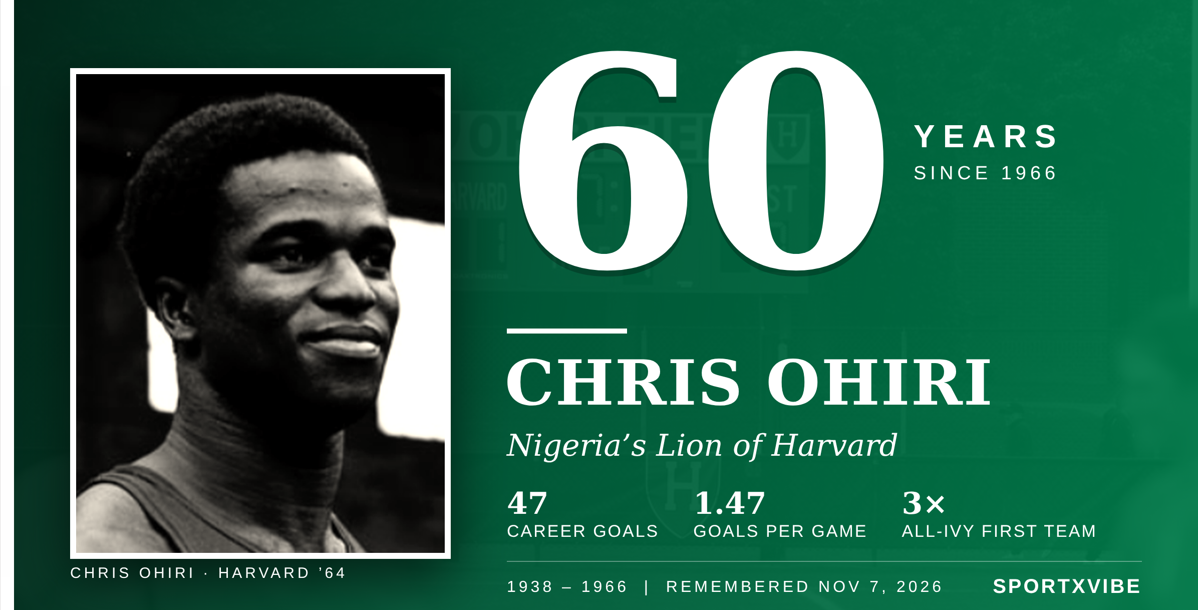
On November 7, 2026, it will be exactly 60 years since Chris Ohiri died. Many Nigerian sports fans still don’t know his name.
Walk onto the Harvard campus in Cambridge, Massachusetts, and you will find a soccer field named after a Nigerian. It is Chris Ohiri Field, and it honours a young man from Owerri who arrived in America in 1960 and left a mark that outlasted his short life.
Ohiri’s story is worth telling again. It is a story about talent, education and sacrifice, and it speaks directly to every Nigerian student-athlete trying to balance the classroom and the pitch.
A champion before Harvard
Before he ever saw Harvard Yard, Ohiri had already built a reputation at home. He won the Challenge Cup with Port Harcourt Red Devils in 1958, and he was reported to be a national champion in both boxing and the decathlon. He also played for the Nigerian national team in the qualifiers for the 1960 Rome Olympics, scoring twice.
Then came a door that very few Nigerians could walk through. In 1959, Harvard’s Director of Admissions, David Henry, visited Nigeria while the country was still preparing for independence. Nigeria had just one university at the time, and an Education ministry official, Stephen Awokoya, urged Henry to take as many students as he could. About two dozen Nigerians were selected, Ohiri among them. It was an early step in what became the African Scholarship Program of American Universities (ASPAU).
The numbers that built the legend
Ohiri’s freshman season reads like a typing error:
- 8 goals in his first appearance for the Harvard freshman team
- 36 goals in 9 games before the season was over
- 47 career goals, which made him the leading Ivy League scorer of his era
- 1.47 goals per game across his career, an average almost no one in American college soccer has matched since
- 13 consecutive games with a goal, ending in his senior-year win at Yale
- An All-America selection after his final season
His shooting power was a legend in itself. Reports from the time say he knocked out several opposing goalkeepers, and one of his shots sent a keeper to hospital. His roommate David Straus recalled that Ohiri was so far ahead of the field that he would announce he was about to score, then score.
Harvard’s athletics director, John Reardon, noted that Ohiri was not the usual recruited athlete, yet “he could kick a soccer ball like you can’t believe.” His teammate John Thorndike was blunter: “He could have played on any team in the world.”
He was not only a footballer. Ohiri’s triple jump mark at Harvard stood for more than 40 years, until Samyr Laine broke it in 2005.
A man as good as his goals
What makes Ohiri’s legacy last is that the people around him remembered the person as much as the player. Teammate Stephen Sewall called him “an angel” off the field and “a lion” on it. Others spoke of his seriousness of purpose and his calm presence. He graduated magna cum laude, then went on to Harvard Business School, with spells at the United Nations and IBM along the way.
That mix of academic excellence and elite sport is exactly what Nigerian student-athletes are chasing today.
A final journey home
In 1966, Ohiri collapsed on a tennis court at Harvard Business School and was diagnosed with a terminal illness. Accounts differ on whether it was leukemia or lung cancer. He chose to return to Nigeria with his wife, Shirley, during one of the most violent years in the country’s history. He died on November 7, 1966.
Seventeen years later, Harvard named its soccer field in his honour. The plaque remembers him as an “eager scholar, loyal teammate, skilled athlete.”
Why Ohiri matters to Nigerian student-athletes today
Six decades on, Nigerian players are common sights in American college sports. Andre Akpan matched Ohiri’s Ivy League scoring mark in 2010. Yet Ohiri’s name is far more familiar at Harvard than in the country he represented. That gap is the reason this tribute exists.
Ohiri’s life offers three lessons:
- Talent opens doors, but education sustains you. He earned both a degree and a place in history.
- Excellence can come from anywhere. A “backwater” Nigerian talent became the biggest thing to happen to Harvard soccer.
- A legacy needs storytellers. Records fade unless we keep telling the story.
Join the 60th anniversary tribute
As November 7 approaches, SportXVibe invites you to help bring Chris Ohiri home in memory:
- Share this article with a student-athlete, coach or teacher.
- Tell us what Ohiri means to you in the comments or on social media with #OhiriAt60.
- Follow SportXVibe for our remembrance coverage and more stories of Nigerian student-athletes.
Sixty years later, the Lion of Harvard should be a household name in Nigeria.